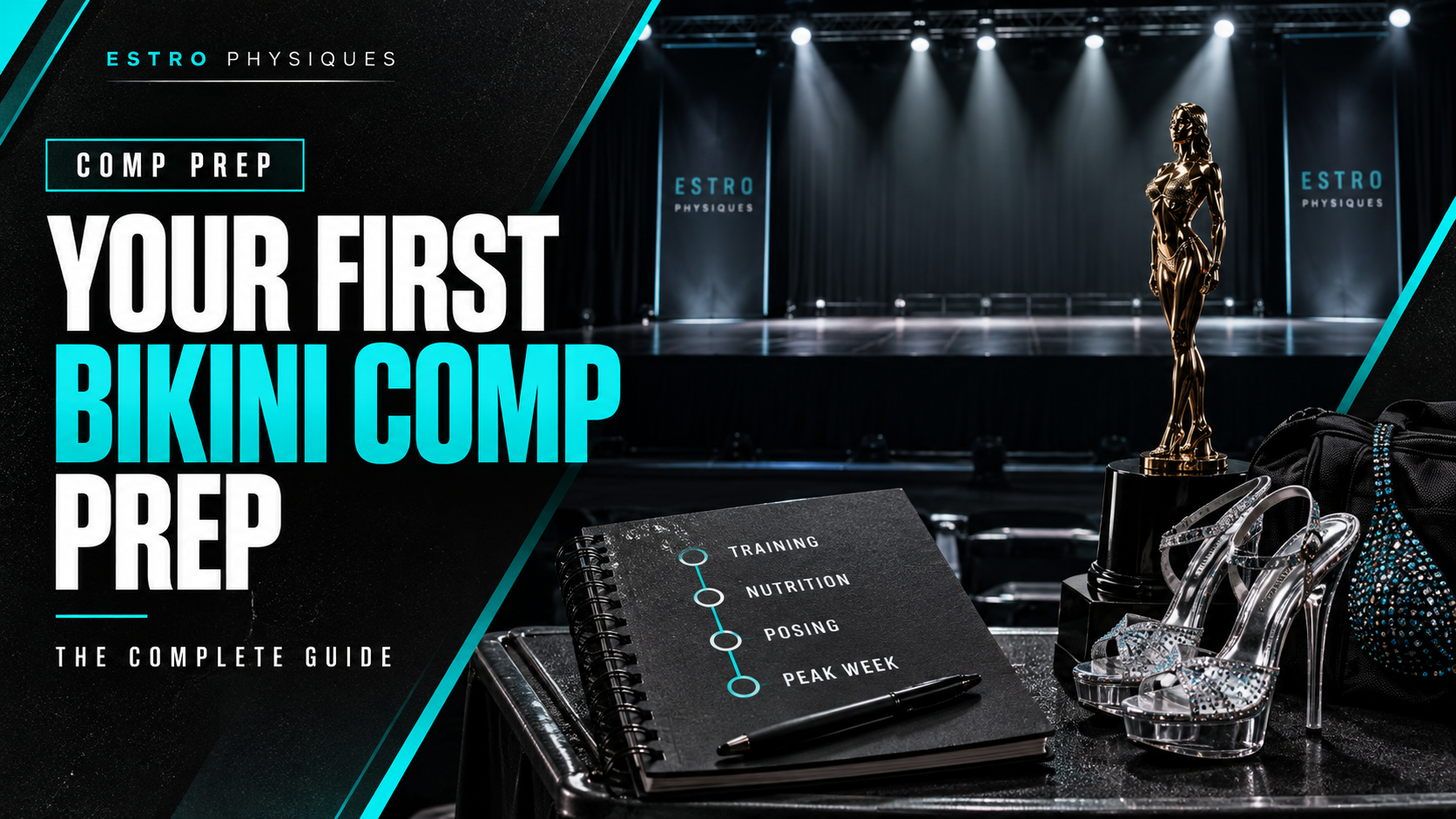
How to Prep for Your First Bikini Competition: A Complete Guide for Women
So you’re thinking about stepping on stage. Maybe a coach planted the idea, maybe you watched a friend compete and something clicked, or maybe you’ve just decided you want a goal bigger than the one you’ve been chasing in the gym. Whatever brought you here, your first bikini competition is one of the most rewarding things you can do for your body and your confidence, as long as you do it the right way.
Here’s the truth most of the internet won’t tell you: prep doesn’t have to be miserable, and it definitely doesn’t have to wreck your health. Crash diets, two-a-day cardio sessions and zero carbs aren’t a badge of honour: they’re a sign of a plan that wasn’t built properly. This guide walks you through how first-time competition prep actually works, so you can show up on stage proud of how you got there, not just how you look.
First, what competition prep actually is
Competition prep is the structured process of getting your physique “stage ready” for a bodybuilding show: in your case, the bikini division. It’s a window of focused training, nutrition and posing practice that brings your body fat down, keeps your hard-earned muscle, and teaches you to present it under stage lights.
What it isn’t: starvation, punishment, or a 12-week sprint of doing the most extreme thing possible. Done well, prep is the opposite: a measured, progressive plan where small changes are made over time, and your energy, sleep, training performance and mindset are monitored the whole way through. The goal is to peak on one day feeling your best, not to limp to the stage running on empty.
Choosing your federation and division
Before you plan a single meal, you need to know what you’re prepping for. In Australia there are several federations: ICN, IFBB, WBFF and NABBA among them. Each has its own divisions, judging criteria and “look.” The bikini division generally rewards a balanced, athletic shape with toned glutes and a tight waist, but the exact standard varies between federations.
This matters more than first-timers realise. Prepping for a federation that wants a softer, more commercial look is different from prepping for one that rewards more muscle. Pick your show and division first, then reverse-engineer your prep from the standard the judges are actually looking for. If you’re unsure, this is the single best thing to get a coach’s eyes on early.
Tip: Go and spectate a local show before you commit. Watching a class be judged in person teaches you more about “stage ready” than a hundred Instagram posts.
How long does competition prep take?
This is the question every first-timer asks, and the honest answer is: it depends on where you’re starting. Most first preps run somewhere between 12 and 24 weeks, but that number is set by how much body fat you need to lose to hit stage condition, not by a calendar.
Starting further out is almost always better for a first-timer. A longer runway means a slower, more sustainable fat-loss rate, more muscle retained, fewer brutal calorie cuts, and time to actually learn to pose. If a plan promises to get you stage-ready in six weeks from a non-athletic starting point, that’s a red flag, not a selling point.
Rule of thumb: Build first, prep second. If you’re newer to lifting, spending a year building muscle in a structured off-season before your first prep will give the judges something to reward.
Training during prep
Your training in prep has one main job: keep the muscle you built so that when the fat comes off, there’s a defined, balanced shape underneath. That means resistance training stays the priority from start to finish. You don’t “tone” with endless light reps: you keep lifting with intent and let nutrition reveal the work.
Resistance training
Expect a structured program built around progressive overload, with extra attention on the areas bikini judges focus on: glutes, hamstrings, back and shoulders for that balanced V-taper. As prep goes on and energy drops, your program should adjust intelligently rather than just piling on more volume.
Cardio
Cardio is a tool to help create an energy deficit, not a punishment for eating. A good plan introduces cardio gradually and keeps as much as possible in reserve, so there’s somewhere to go if fat loss stalls late in prep. If you’re doing hours of cardio in week one, you’ve got nothing left for week ten.
Nutrition: why the extremes backfire
Stage condition is a fat-loss outcome, which means nutrition does most of the heavy lifting. But “eat less, train more” taken to its extreme is exactly how women end up exhausted, losing their period, bingeing, and rebounding hard after the show.
A well-built prep uses the smallest effective deficit: enough to lose fat steadily (often around 0.5 to 1% of body weight per week), with protein kept high to protect muscle, and carbs and fats adjusted over time as needed. You should be eating enough to train hard and function in your actual life. Hunger is normal in the final weeks; feeling broken for the entire prep is not.
Watch for these warning signs: losing your period, constant dizziness, sleep falling apart, mood crashing, or strength dropping off a cliff. These aren’t “part of prep,” they’re signals the plan needs adjusting.
Posing: the skill that wins (or loses) classes
Here’s what shocks most first-timers: two women can bring near-identical physiques to the stage, and the one who poses better places higher. Posing is how you present every hour of work you put in, and it’s a skill, which means it’s learnable and it needs practising long before show week.
Bikini posing has its own walk, quarter-turns, and presentation style, and it differs by federation. Start practising in heels early, film yourself, and treat posing as a weekly training session in its own right. Confidence on stage doesn’t come from hoping: it comes from having rehearsed your routine until it’s automatic.
Peak week and show day, demystified
“Peak week” is the final week before your show, where small adjustments to food, water and training are used to present your physique at its best. It has a mythical reputation online, but for a first-timer the best peak week is usually a calm, simple one, not a dramatic manipulation of water and carbs that leaves you flat, bloated or panicking.
On show day itself you’ll have tan applied, check in with the judges, and spend a surprising amount of time waiting backstage. Expect nerves: they’re part of it. Come with a plan for food, your suit, your heels, your tan and your timings, and the day feels exciting rather than chaotic. Your only job on stage is to present what you built and enjoy it.
The mental side: your health comes first
Prep is as much a mental challenge as a physical one. The discipline that gets you to the stage is real, but so is the risk of tying your self-worth to a number on the scale or a placing. The healthiest competitors go in with perspective: the trophy is a bonus, the transformation and what you learn about yourself is the real win.
This is exactly why it matters so much to work with coaches who understand the female body: hormones, menstrual health, and the realities of dieting as a woman. Prep should leave you healthier and more confident, with a body you can maintain, not a crash you spend the next year recovering from.
After the show: don’t skip the off-season
What happens after you step off stage is just as important as the prep itself. Coming out of a deficit, your body is primed to regain weight quickly, and without a plan that’s where a lot of first-timers come unstuck. A structured reverse diet, gradually bringing calories back up, helps you hold your condition longer, restore energy and hormones, and transition into a productive off-season where you build the muscle that makes your next prep even better.
Think of competing as a cycle, not a one-off event: build in the off-season, reveal in prep, recover with intention, repeat. That’s how women compete for years and stay healthy doing it.
Do you need a coach for your first prep?
You can find free training and nutrition information anywhere. What you can’t easily get on your own is an experienced, objective eye on your physique, your division standard, your rate of fat loss, your posing and your wellbeing, adjusting all of it in real time. For a first prep especially, a good coach is the difference between guessing and knowing, and between a prep that breaks you and one that builds you.
At Estro Physiques, competition prep is exactly what we do, with an all-female coaching team who’ve been on stage, through the diets, and out the other side. We coach the whole woman: your training, your nutrition, your posing, your hormones and your head, with results that don’t cost you your health.
Thinking about your first show? Book a free consult with the Estro Physiques team and let’s map out a prep that’s built for you: your body, your goals, your timeline. No extremes. Just expert coaching that gets you to the stage proud of how you got there.