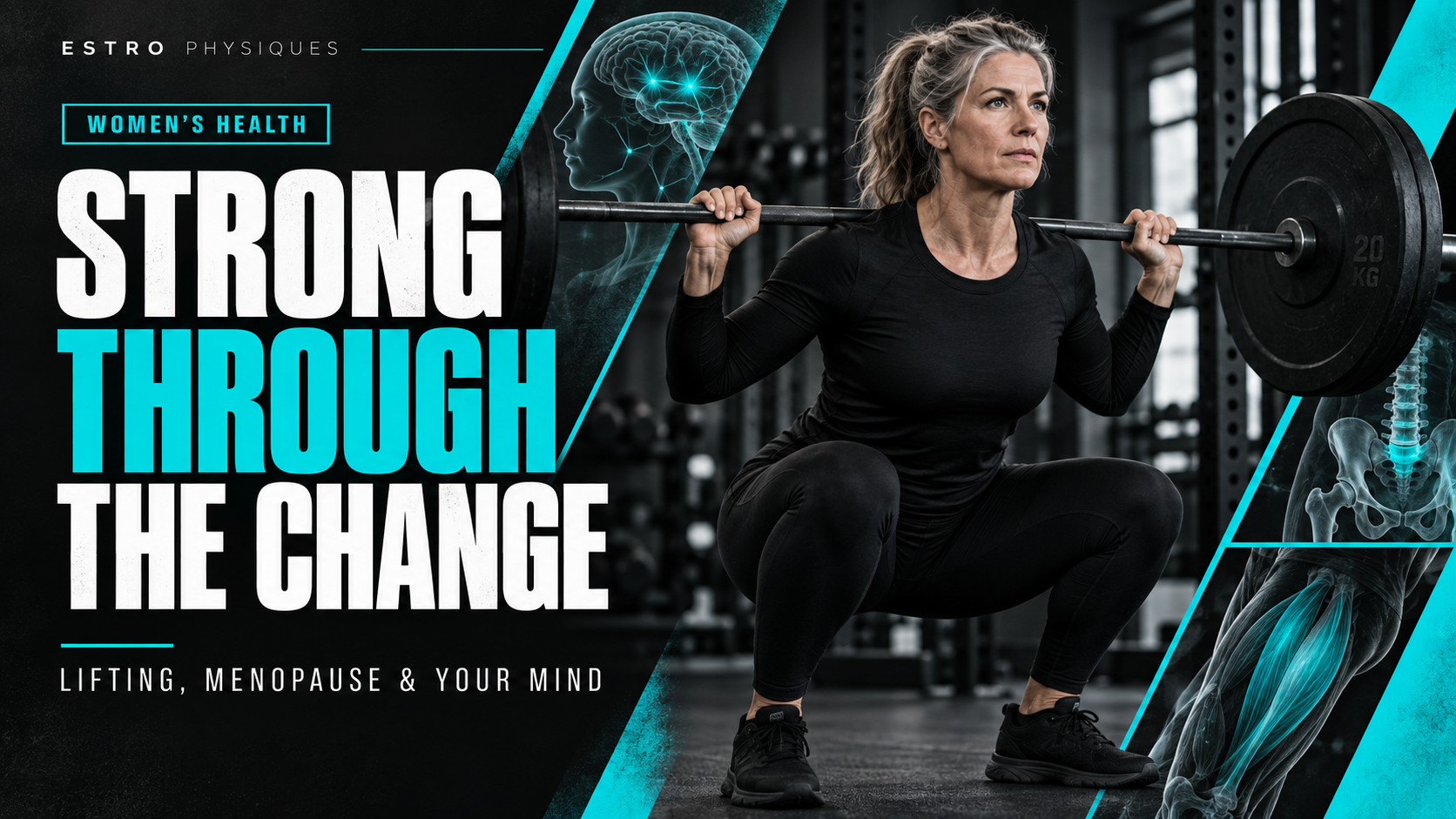
Strong Through the Change: What 2026 Research Says About Lifting, Menopause and Your Mind
If you’ve ever wondered whether it’s “too late” to start strength training, or whether picking up weights will somehow make you bulky rather than better, the newest research has a clear and encouraging answer. A run of studies published over the past few months reinforces something we see every day in the clinic: building strength is one of the most powerful things a woman can do for her bones, her muscles, and her mental health — at every stage of life, and especially through perimenopause and beyond.
Here’s what the latest evidence is telling us.
Why strength matters more after menopause
The drop in oestrogen that comes with menopause accelerates the loss of both muscle and bone. Women tend to reach a lower peak bone mass than men to begin with, which means fracture risk climbs steeply in the years after the final period. The good news is that the right kind of exercise directly counteracts this.
A 2026 systematic review in Osteoporosis International looked at high-intensity resistance and impact training (HiRIT) — think heavier lifts like the overhead press, squat, deadlift and leg press, combined with controlled jumping or impact work — across 39 studies and nearly 3,400 peri- and postmenopausal women (average age 57). The review confirmed HiRIT has become a leading strategy for protecting bone and physical function during and after menopause. It also flagged that the way these programs are delivered matters: progression, individual tailoring and good supervision are what make them both safe and effective — exactly the role a qualified exercise physiologist plays.
The biology backs this up. A small 2026 crossover trial in Bone compared a heavy squat session against interval running in postmenopausal women and found that resistance exercise produced a stronger short-term bone-signalling response 24 hours afterwards. Both forms of exercise are valuable, but loading your skeleton with resistance work appears to send a particularly useful “build” message to bone.
The “I’ll get bulky” myth needs to go
One of the biggest barriers isn’t physical — it’s the lingering belief that lifting weights isn’t for women, or that it will cost them their femininity. A 2026 article in Annals of Medicine, pointedly titled “Strength unseen,” examined the prejudice women still face around resistance and weight training. The authors note that women who don’t lift tend to perceive far higher barriers than women who do, and that these barriers are shaped by outdated cultural norms rather than biology. Their conclusion is worth repeating: the health benefits of resistance training for women are clear and well established — the real work is dismantling the stigma that keeps women out of the weights area.
For most women, building meaningful strength and protecting bone density simply does not produce the dramatic muscle gain the myth imagines. What it does produce is independence, better balance, fewer fractures and more capable everyday movement.
Could nutrition give your training a boost?
A 2026 meta-analysis in the Journal of the International Society of Sports Nutrition (led by researchers at Edith Cowan University here in Australia) pooled seven randomised controlled trials of creatine monohydrate in postmenopausal women. When creatine at 5 grams or more per day was combined with resistance training, women saw small but meaningful gains in lean muscle mass and leg-press strength, with no evidence of harm and side effects no different from placebo. Lower doses without training showed no effect, and the effect on bone density remained unclear.
The takeaway isn’t that everyone should rush out and buy supplements — creatine is worth a conversation with your GP or dietitian, especially if you have kidney concerns — but it’s a reminder that the foundation is the training itself, with nutrition as a potential add-on.
Movement is medicine for the mind, too
Strength and bone health are only half the story. A growing body of 2026 research underlines how strongly physical activity supports women’s mental wellbeing.
A large US study of more than 112,000 adults (nearly 80% women) published in Frontiers in Public Health found that those whose lifestyles best aligned with healthy-behaviour guidelines — including regular physical activity — were significantly less likely to report symptoms of depression and anxiety several years later. A separate 2026 study of women of reproductive age in African Journal of Reproductive Health found that community sport participation was linked to fewer symptoms of depression and anxiety and higher life satisfaction, partly through the social connection and physical activity it provides.
For women navigating pregnancy, a 2026 network meta-analysis in Archives of Women’s Mental Health pooled 36 trials and over 4,500 participants. It found moderate-intensity aerobic exercise was most effective for reducing prenatal depression, while yoga was particularly helpful for anxiety — with sessions around three times a week over 12 weeks producing the biggest benefits. (As always, exercise in pregnancy should be guided by your health team.)
The thread running through all of this: moving your body, in a way you enjoy and can sustain, is one of the most reliable, side-effect-free tools we have for protecting mental health.
What this means for you
- It’s never too late to start. The clearest benefits in this research come from women in midlife and beyond.
- Lift with intent. Progressive resistance training — done with proper technique and gradual loading — is what protects bone and builds strength. This is where professional guidance pays off.
- Aim for consistency, not perfection. Around three sessions a week, sustained over months, is what shifts the dial.
- Don’t fear the weights. The “bulking up” worry is a myth; strength training builds capability and confidence.
- Move for your mind as well as your body. The mental-health benefits are real, and social, enjoyable movement amplifies them.
If you’d like a strength program designed around your body, your goals and your stage of life, that’s exactly what we do. Get in touch with the team to get started.
This article is general information and isn’t a substitute for individual medical advice. Please check with your GP or health professional before starting a new exercise program, particularly if you’re pregnant, have osteoporosis, or are managing a health condition.
References
Research summarised in this article was sourced from PubMed.
- Tortoli E, et al. High-intensity resistance and impact exercise in menopausal women: a systematic review of intervention reporting quality and training content. Osteoporos Int. 2026. doi:10.1007/s00198-026-08078-3
- Guisado-Cuadrado I, et al. Resistance and interval running exercise exert differential short-term post-exercise bone metabolic marker responses in postmenopausal women. Bone. 2026. doi:10.1016/j.bone.2026.117910
- Hong J, et al. Strength unseen: confronting prejudice in women’s resistance and weight training. Ann Med. 2026. doi:10.1080/07853890.2026.2661150
- Naddafha S, et al. Creatine monohydrate for lean mass, strength, and bone density in postmenopausal women: a systematic review and meta-analysis. J Int Soc Sports Nutr. 2026. doi:10.1080/15502783.2026.2668435
- Chiang KE, et al. Co-occurring health behaviors and mental health outcomes among a large, aging US population. Front Public Health. 2026. doi:10.3389/fpubh.2026.1817690
- Zhang C. Community sport participation and mental wellbeing among women of reproductive age in China: A quantitative study. Afr J Reprod Health. 2026. doi:10.29063/ajrh2026/v30i9s.12
- He L, et al. Multidimensional psychological and neurophysiological effects of moderate- and low-intensity exercise on pregnant women: an integrative systematic review and Bayesian framework network meta-analysis. Arch Womens Ment Health. 2026. doi:10.1007/s00737-026-01709-y